

By The Chilltown Blues
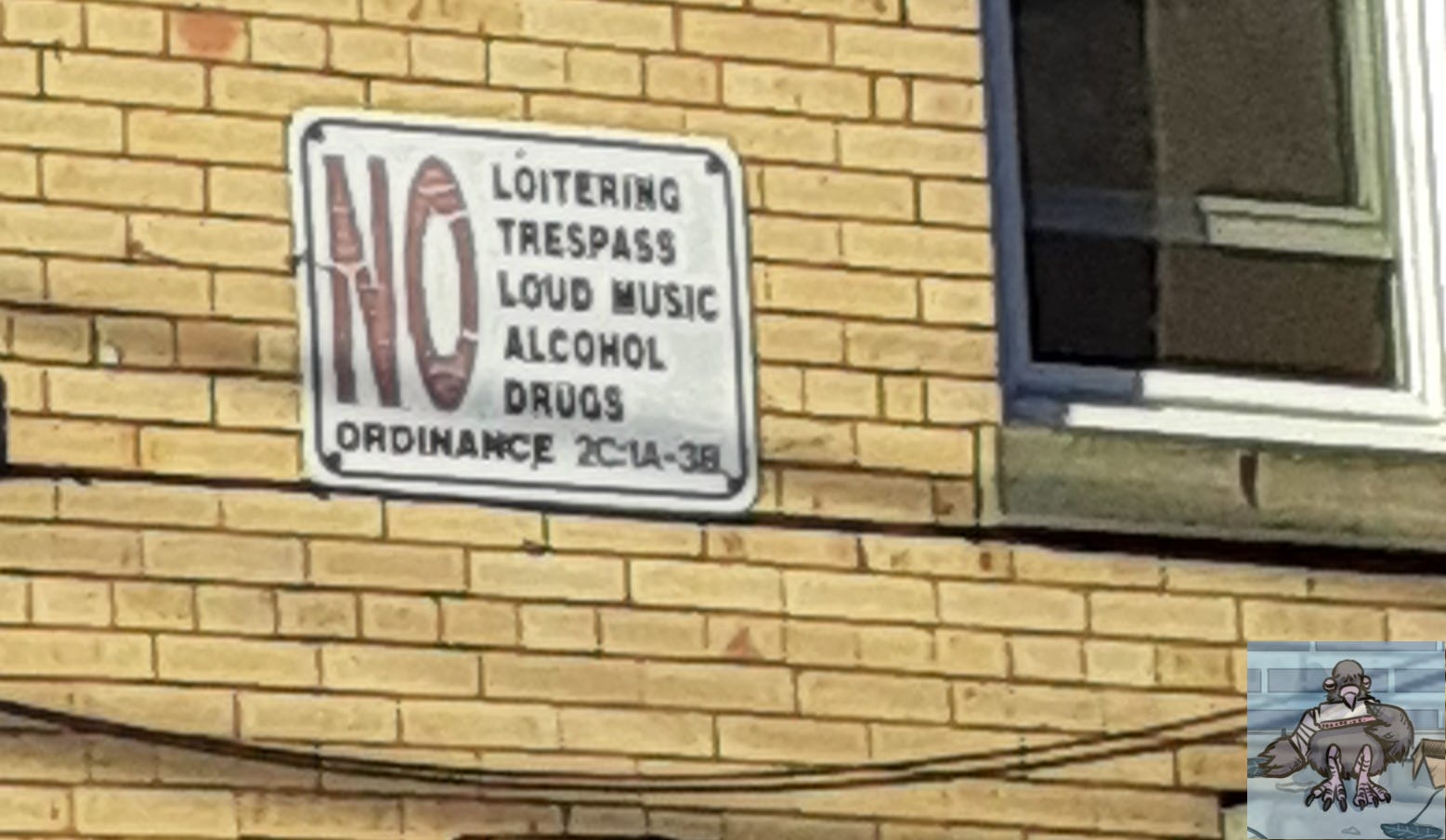
The signs were everywhere, once upon a time, for someone who grew up around buildings in Chilltown or Newark or the Bronx. And they seemed almost draconian.
NO LOITERING, TRESPASS, LOUD MUSIC, ALCOHOL, DRUGS
Of course the sign was hardly a guarantee. It just showed the landlord cared on some level about their tenant’s quality of life. Note that when these signs went up it was more common for a landlord or superintendent to live in a building and be one of the people invested in the tenets of that sign.
Because really what that signs speaks is a failure of infrastructure.
Those signs went up because every one of those things — loitering, trespassing, loud music, (open use of) alcohol and drugs — was much more likely to happen either in the building itself or the given area around it. When any one of those things happened, it was possible at least three were happening at the same time.
The specific ordinance referenced in the sign pictured above is one on the state level about trespassing. That it used a state’s, instead of a local one, is telling. The late noise expert Dr. Arline Bronzaft decried how, with Reagan’s defunding of the Office of Noise Abatement and Control in the earlier eighties, there was little federal protection from noise pollution, and local ordinances have not been meaningfully revised as the world got noisier.
If the city fails people, they are supposed to look to the state, if that fails them, they’re supposed to look to the federal government … and well, now is the embodiment of post-Reagan and post-Lyndon B. Johnson, whose policies to help create equity unintentionally, one urban planner and historian argued, by leading to a prevalence of partnerships with for-profit corporations to help facilitate that equity.
Last year, the group Sustainable JC created a map of environmental stressors with data from the New Jersey Department of Health.
“Community stressors are facilities causing negative environmental or public health impacts,” Sustainable JC’s report on the map said. “These stressors disproportionately affect overburdened communities, which are consensus block groups with low-income households or minority residents.”
The map shows polluting facilities, with three scrap metal facilities in ward F (containing much of the city’s historically redlined Black neighborhoods), two in ward A (containing the rest of those redlined neighborhoods) and one in every other ward.
According to the map, Ward C has a solid & hazardous waste site, which the EPA defines as “ a location where solid waste, which can include hazardous materials, is managed, treated, or disposed of”;
And Ward A has a major AQ permitted site — a “facility that has the potential to emit 100 tons per year of any air pollutant or 10 tons per year of a single hazardous air pollutant,” according to the EPA.
The scrap metal facilities in wards F and A are notable because a shredder such facilities in general have either used in the past or still use can cause residue to be in the air if that facility is not in tip top shape.
There’s a proposed bill for the NJ Assembly, No. 2406, waiting to be introduced in the 2026-2027 session pending technical review that would “establish minimum operational requirements for scrap metal facilities that operate shredders, in addition to all other requirements pertaining to recycling centers.
“These requirements include, but are not limited to … (among other things) the enclosure of any shredder residue to prevent dust migration.”
So, hypothetically, if a facility was slacking in some regards, the possibility of dust migration in the air around it is something someone in its vicinity would likely want to know about. Breathing in such dust increases the chances of health complications.
This is the kind of health-adverse possibility that is not unheard of in NJ, but it is one whose dangers are sadly easy to ignore. (Why that proposed bill is a no-brainer).
If a facility or watch-person were lapsed enough to make dust migration a problem, it’s a problem that floats in the air quietly and invisibly.
Least politically acknowledged environmental stressor?
There are some environmental stressors that aren’t easy to ignore or pretend isn’t there. Those are what the “NO ….” sign speaks to — the way a single house or building or even an apartment can be an environmental stressor. Every one of these is now capable of having something that produces block-level party noise.
Noise that came with block parties happened with conditions and a general consensus among people on that block.
Block-party-level noise that comes from does not come with these things; it comes with the kind of person who, at best, is indifferent. At worse, for anyone who’s ever been on a bus or even the sidewalk as a person blasts music from their phone or a mini-speaker they’re carrying, the profile is generally clear. If not indifference, there’s a lack of control over their lives that controlling a soundscape fills, and to get between them and that is to tap a nerve.
(This, along with the lack of response, is the reason people in non-gentrified neighborhoods have been portrayed as caring less about loud music. Anyone who’s lived on the block knows it’s not worth trying to reason with someone who is, at best, indifferent.)
Noise pollution elevates people’s heart rates, can permanently damage their hearing and is generally terrible for someone’s mental health. It makes it harder to learn, from the cradle onward.
At its worse, it literally is pushing the button in the brain that says fight or flight, and if someone can’t get that noise to stop, or doesn’t feel like leaving the vicinity, the brain and body don’t really get used to it — though with incredible amounts of being constructive, with money to buy $300 noise-canceling headphones for every person in one’s home, that can be mitigated to some degree.
As it states in Jersey City’s noise ordinances (revised in 2017):
“Excessive sound is a serious hazard to the public health, welfare, safety, and the quality of life … It is the policy of the City of Jersey City to prevent excessive sound that may jeopardize the health, welfare, or safety of the citizens or degrade the quality of life.”
That sure sounds good and meaningful, doesn’t it?
Noise pollution is a universal problem but at its worst its often a class issue; and it is the Chilltown Blues line that media along traditional lines has reflected weak tea reports from a class largely insulated from the worst of it.
r-e-s-p-e-c-t
We’re not capitalizing “respect” because yearning for respect beyond a (albeit elusive) basic kind is poisonous, but noise pollution is something that at its basic level Dr. Bronzaft boiled down to the lowercase version.
That sign, the “no loitering …” sign, addresses all the tenets of a reasonable quality of life. One should not think about them as the tenets that Karens warp to try to exert their own lacking sense of self worth, but rather the person returning to a building in a disenfranchised neighborhood and having to deal with people who aren’t just trespassing in the most technically correct way; no, people who are making themselves at home.
That sign is a warning that someone is about to enter a place where the system generally doesn’t respect people as deserving of what its officials, our impression has been, tend to have themselves.
There are a few signs that remain on buildings in areas gentrified to the point where the sign’s tenets are more bolstered, however imperfectly, but our impression is they’re largely in or just adjacent to redlined territory.
In a peace for the Montgomery County Quiet Skies Coalition, Dr. Bronzoft posed a few questions about said respect: “Are our government officials respecting citizens by not funding the EPA’s Office of Noise Abatement and Control, which was created to carry out the mandate of the Noise Control Act, with its stated intent to protect human health? … Are agencies empowered to enforce noise bylaws respectful if they fail to enforce these bylaws?”
No third space blues
Some people chalk up the “no loitering …” signs as indicators that there are no third spaces — spaces in which people can congregate, unwind, community-build, etc. Those kinds of places are disappearing everywhere. The more expensive real estate is, the less likely it is that even a relatively low-scale for-profit business can exist and thus try to serve as the kind of third space that isn’t just a glorified for-profit.
But because such statuses trickle upward and not downward, the lack of them can be particularly felt in places that are disenfranchised; and when that’s the case, people are that much more likely to try to do what people do everywhere unless there’s infrastructure that counters it, make a third space wherever you can — and though not necessarily, probably not in a particularly constructive way.
Mayor
So far Mayor Solomon’s tenure has been defined by two things, we would say.
One, is the property tax hike, which nobody likes.
We would also say, however, that outside of the money the city was importing in its uber-NYC-centric and their “JC is livable again?” semi-suburban counterparts, the city infrastructure-wise felt like it was held together by gum, tape and paint; and that we can scarcely think of examples of what an equitably well-funded city looks like — outside, of to some degree, what Mayor Zohran Mamdani is doing in NYC.
The other thing that was notable for us is the energy that came with this determination that seems like “be the anti-Fulop.”
There was, for a time anyway, in our estimation, a less robotic and/or “whatdoyawant!?” response when seeking city services. But such things tend to normalize to closer to the base (in this case, that would be the decade-plus Fulop-era standard) after a while.
If the coffers are more full, where does that energy go exactly? All the leading candidates in the last mayoral election talked about making new housing more equitable. Solomon’s campaign included talking about neighborhood watches to help with public safety — an idea we would firmly put in the camp of “tell me you’ve never lived in a disenfranchised neighborhood without telling me you’ve never lived in a disenfranchised neighborhood.”
We believe that energy should go toward bolstering the city from bottom up, and that it should do so in a way that does not placate and benefit a “that’s fine for them” status quo.
Beyond and including that, in all this terrible semi-normalcy, we’re reminded of former mayoral candidate and county Commissioner Bill O’Dea.
Our impression was that he wasn’t any more responsive to challenging inquiries than the average politician. One of the flaws of O’Dea’s campaign was its lack of verve; the other flaw that may be quite the ongoing mountain climb is the lack of appeal that can come with being a longtime fixture of this city to voters downtown — some of whom, we would say, have spent the last hyper-gentrifying decade and half mourning the influence that they (as being comprised of the highest-income-havers in the city) would traditionally have many other places (NYC, excepting) being dwarfed by the whims of developers.
But O’Dea had promised to spend three days a week in the City Hall Annex on MLK. Now, some streets aren’t knowable unless someone walks their nook and crannies instead of passing them in a car, which is very possible even for a mayor, but knowing the mayor of the whole city was spending a good chunk of his working hours in/adjacent to its most demanding areas to live in — that feels like it might have changed the compass in the air, the one by which Chilltown Blues looks elsewhere as much as here.
This piece (phew) is made available sans paywall for a limited time thanks to our paid subscribers. Please consider becoming a free or paid subscriber, if you have the means. We know it’s tough times. You can also visit our support page, or, if you like, buy a shirt or something else we’ve designed at chilltown-blues-shop.fourthwall.com.